
Affordable luxury jewelry is creating new opportunities for retailers as consumers explore alternatives to traditional precious gemstones. Laboratory-created stones allow businesses to offer attractive designs at different price points without relying entirely on mined diamonds. The Federal Trade Commission (FTC) identifies moissanite and other laboratory-created gemstones as options that can cost less than their natural counterparts.
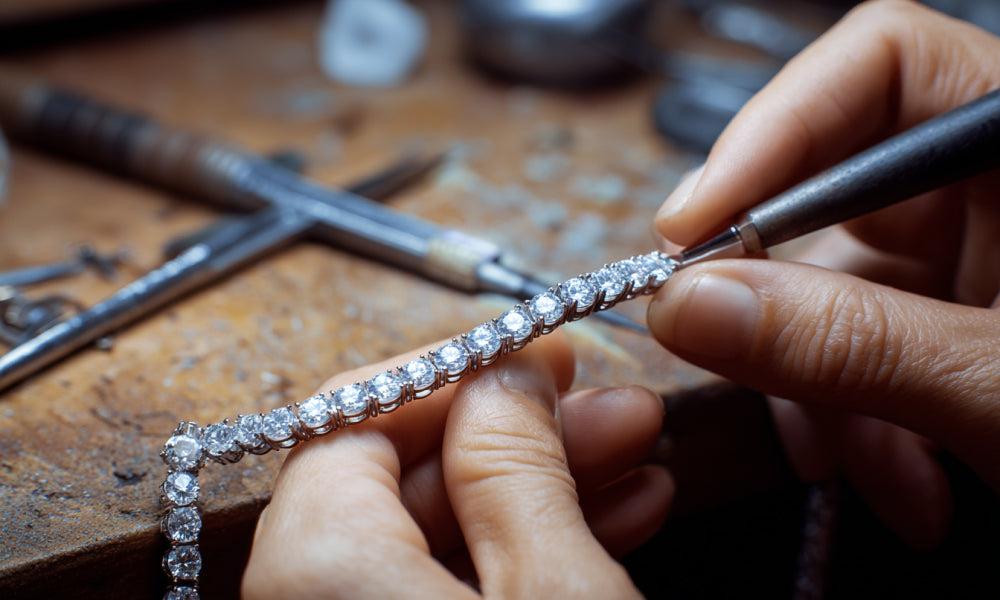
A moissanite tennis bracelet illustrates how retailers can position alternative gemstones within the affordable luxury market. Its continuous row of sparkling stones offers the appearance of fine jewelry while giving businesses another pricing option. For customers, this means choosing jewelry based on design, materials, and budget rather than gemstone tradition alone.
Why Consumers Are Exploring Alternative Gemstones
Jewelry buyers have different priorities. Some value the history and rarity of natural diamonds, while others focus on appearance, durability, and affordability. These preferences create opportunities for retailers to serve customers with different expectations.
Moissanite is particularly interesting because of its optical properties. Research published by the Gemological Institute of America (GIA) identifies synthetic moissanite as silicon carbide, a material with strong brilliance and a hardness of approximately 9.25 on the Mohs scale. Its appearance resembles diamond, although the two gemstones have different chemical and optical properties.
For jewelry businesses, these characteristics provide an alternative to traditional diamond-centered collections. Retailers can develop products around the visual appeal of sparkling gemstones while explaining their material differences clearly.
Affordability also creates room for experimentation. Customers who hesitate to purchase expensive diamond jewelry may consider alternative stones for everyday accessories, gifts, or special occasions. This broadens the range of purchasing decisions that jewelry retailers can address.
What Changes When Gemstone Costs Are Lower?
Gemstone selection influences the cost of manufacturing jewelry. The type, size, quality, and quantity of stones affect material expenses, while metal choice, craftsmanship, and production volume contribute to the final cost.
Lower-priced gemstone alternatives can give manufacturers greater flexibility when developing collections. A retailer might introduce larger stones, elaborate settings, or coordinated jewelry sets without adopting the same material budget required for comparable natural diamond designs.
However, affordable gemstones do not automatically mean inexpensive production. Cutting, polishing, metalwork, stone setting, packaging, and quality inspection still require investment.
Businesses must also consider the relationship between production cost and retail price. A lower material cost creates an opportunity to offer competitive pricing, but profitability depends on controlling other expenses and maintaining consistent product quality.
This makes supplier selection important. Retailers need dependable specifications, consistent gemstone appearance, and reliable manufacturing standards to reduce returns and protect customer confidence.
How Retailers Can Build a Strong Pricing Strategy
Affordable luxury works best when businesses understand the customers they want to reach. A retailer targeting everyday shoppers may emphasize accessible prices and practical designs. Another targeting occasion buyers might focus on craftsmanship, distinctive settings, and premium presentation.
Offering several price levels helps businesses serve both groups. Entry-level collections can feature simple designs, while higher-priced pieces may use precious metals, larger gemstones, or more detailed settings.
Pricing should reflect the complete product rather than gemstone cost alone. Packaging, customer service, warranties, shipping, and marketing all contribute to operating expenses.
Retailers also need to communicate value without making misleading comparisons. The FTC advises jewelry sellers to describe gemstone origins and characteristics accurately. Its jewelry guidance distinguishes laboratory-created gemstones from imitation materials and emphasizes clear product descriptions.
For moissanite retailers, transparent information about gemstone composition, metal purity, dimensions, and care requirements can help customers understand what they are purchasing.
Where Are the Business Opportunities?
Alternative gemstones create opportunities for established jewelry retailers and smaller businesses entering the market. Online stores can develop specialized collections without competing exclusively through traditional diamond offerings.
Product variety is one potential advantage. Businesses can offer gemstone bracelets, rings, necklaces, and earrings across several price ranges. Coordinated collections may also encourage customers to purchase matching accessories. For entrepreneurs considering investing in the jewelry industry , understanding customer preferences, production costs, and market demand can help identify opportunities for developing profitable jewelry collections.
Customization provides another opportunity. Retailers can offer different stone sizes, metal finishes, bracelet lengths, and setting styles to accommodate individual preferences.
Digital retailing allows businesses to explain these differences through detailed product pages, photographs, educational content, and customer support. Clear descriptions are especially important when customers cannot examine a gemstone before purchasing.
However, expanding product choices also increases inventory complexity. Businesses must balance variety against storage costs, supplier lead times, and the risk of unsold merchandise.
Can Affordable Luxury Remain Competitive?
The growing availability of alternative gemstones gives jewelry businesses more ways to develop products, but access to affordable materials does not guarantee commercial success.
Competition can make similar designs difficult to distinguish. Retailers may need to invest in original styling, dependable craftsmanship, customer service, and clear product information rather than relying primarily on lower prices.
Businesses should also avoid treating all gemstone alternatives as interchangeable. Moissanite, laboratory-grown diamonds, and cubic zirconia have different compositions and physical properties. The GIA documents moissanite’s distinctive optical characteristics, while the FTC emphasizes the importance of accurately identifying gemstones in retail marketing.
Looking ahead, affordable luxury offers businesses an opportunity to serve customers who want attractive jewelry at manageable prices. The commercial challenge is maintaining product quality, transparent pricing, and customer trust as competition develops. Retailers that understand these requirements can build collections around gemstone alternatives without depending on price alone to communicate value.
Tags: Affordable Luxury, Alternative Gemstones, Moissanite Jewelry, Jewelry Business, Retail Pricing Strategies
Suggested Image Prompts
Image 1: Affordable Luxury Jewelry
Realistic editorial photograph of an elegant jewelry display featuring moissanite bracelets, rings, and necklaces arranged on neutral velvet stands inside a modern jewelry boutique. A professional jeweler examining a sparkling bracelet, soft natural lighting, refined retail atmosphere, realistic gemstone reflections, no logos or readable text.
Image 2: Jewelry Retail and Pricing
Realistic editorial photograph of a female jewelry business owner examining a collection of alternative gemstone bracelets and rings at a modern retail counter. A laptop, jewelry samples, and packaging materials are visible, suggesting product planning and pricing decisions. Natural professional lighting, realistic textures, no logos or readable text.
Image 3: Gemstone Selection and Craftsmanship
Realistic close-up editorial photograph of a professional jeweler carefully examining a sparkling moissanite bracelet with a magnifying loupe. Loose gemstones, delicate jewelry tools, and precious metal settings arranged on a clean workbench. Detailed gemstone reflections, natural studio lighting, no logos or readable text.